













Description
Vintage Religious Art
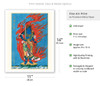
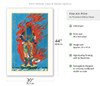
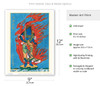
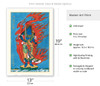
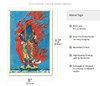
The figure in the image is Fudō Myōō (Sanskrit: Acala), a prominent wrathful deity in Japanese Buddhism. He is known as "The Immovable One" and is a fierce protector of the Buddhist law, believed to cut through ignorance and subdue evil spirits.
Description and Symbolism
Appearance: Fudō Myōō is depicted with a dark blue or black complexion, bulging eyes, and a wrathful, menacing expression designed to intimidate evil forces. He is typically shown with two fangs, one pointing up and one pointing down.
Attributes:
Sword: In his right hand, he holds a flaming sword (the kurikara-ken or "devil-subduing sword") which symbolizes wisdom cutting through ignorance and delusion.
Rope: In his left hand is a rope or lasso used to catch and bind demons and those who block the path to enlightenment.
Flames: He is surrounded by a halo of fire, known as the karura-en (Garuda flame), which represents the purification of the mind by burning away all material desires and attachments.
Rock: He is often shown standing or seated on a rock pedestal, symbolizing his steadfastness and immovability in the face of temptation.
Cultural Context
Fudō Myōō is the chief of the Five Wisdom Kings (Godai Myōō) and an emanation of Dainichi Nyorai (Vairocana Buddha), the central deity in Esoteric Buddhism (Shingon sect). He was historically popular among samurai as a guardian figure and continues to be an important object of worship in Japan today.
The artwork is an antique Japanese drawing, potentially by an artist from the Kano school and possibly from 1878.
View AllClose
The figure in the image is Fudō Myōō (Sanskrit: Acala), a prominent wrathful deity in Japanese Buddhism. He is known as "The Immovable One" and is a fierce protector of the Buddhist law, believed to cut through ignorance and subdue evil spirits.
Description and Symbolism
Appearance: Fudō Myōō is depicted with a dark blue or black complexion, bulging eyes, and a wrathful, menacing expression designed to intimidate evil forces. He is typically shown with two fangs, one pointing up and one pointing down.
Attributes:
Sword: In his right hand, he holds a flaming sword (the kurikara-ken or "devil-subduing sword") which symbolizes wisdom cutting through ignorance and delusion.
Rope: In his left hand is a rope or lasso used to catch and bind demons and those who block the path to enlightenment.
Flames: He is surrounded by a halo of fire, known as the karura-en (Garuda flame), which represents the purification of the mind by burning away all material desires and attachments.
Rock: He is often shown standing or seated on a rock pedestal, symbolizing his steadfastness and immovability in the face of temptation.
Cultural Context
Fudō Myōō is the chief of the Five Wisdom Kings (Godai Myōō) and an emanation of Dainichi Nyorai (Vairocana Buddha), the central deity in Esoteric Buddhism (Shingon sect). He was historically popular among samurai as a guardian figure and continues to be an important object of worship in Japan today.
The artwork is an antique Japanese drawing, potentially by an artist from the Kano school and possibly from 1878.


