













Description
From an Original Color Painting
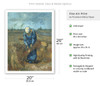
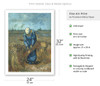
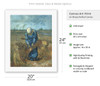
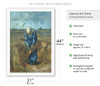
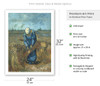
This is a reproduction of a painting titled Peasant Woman Binding Sheaves (after Millet), created by the renowned Dutch Post-Impressionist artist Vincent van Gogh in September 1889.
Artwork Details
Artist: Vincent van Gogh (1853-1890)
Date Created: September 1889, while he was a patient at the asylum in Saint-Rémy-de-Provence, France.
Medium: Oil on canvas on cardboard.
Dimensions: 43.2 x 33.2 cm (approximately 17 x 13 in).
Location: The Van Gogh Museum in Amsterdam, Netherlands.
Context and Inspiration
This work is part of a series of twenty-one copies that Van Gogh made based on prints by his artistic idol, the French Realist painter Jean-François Millet. Van Gogh deeply admired Millet's depictions of the working class and saw their lives as having a noble, almost religious significance.
Van Gogh did not consider these works to be mere copies; rather, he thought of them as "adaptations" of Millet's black-and-white prints into his own colorful, expressive style. By studying Millet's work, Van Gogh aimed to rebuild his self-confidence, which had been damaged by his mental illness, and practice figure painting when live models were unavailable. The vibrant blues and golden yellows used in the painting were colors he strongly associated with the hard toil of peasant life.
View AllClose
This is a reproduction of a painting titled Peasant Woman Binding Sheaves (after Millet), created by the renowned Dutch Post-Impressionist artist Vincent van Gogh in September 1889.
Artwork Details
Artist: Vincent van Gogh (1853-1890)
Date Created: September 1889, while he was a patient at the asylum in Saint-Rémy-de-Provence, France.
Medium: Oil on canvas on cardboard.
Dimensions: 43.2 x 33.2 cm (approximately 17 x 13 in).
Location: The Van Gogh Museum in Amsterdam, Netherlands.
Context and Inspiration
This work is part of a series of twenty-one copies that Van Gogh made based on prints by his artistic idol, the French Realist painter Jean-François Millet. Van Gogh deeply admired Millet's depictions of the working class and saw their lives as having a noble, almost religious significance.
Van Gogh did not consider these works to be mere copies; rather, he thought of them as "adaptations" of Millet's black-and-white prints into his own colorful, expressive style. By studying Millet's work, Van Gogh aimed to rebuild his self-confidence, which had been damaged by his mental illness, and practice figure painting when live models were unavailable. The vibrant blues and golden yellows used in the painting were colors he strongly associated with the hard toil of peasant life.