







Description
From a Vintage Lithograph
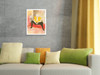
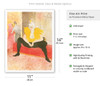
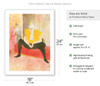
This is a reproduction of the celebrated color lithograph entitled "The Seated Clowness (La Clownesse assise)", created in 1896 by the French Post-Impressionist artist Henri de Toulouse-Lautrec.
Artwork Details
Artist: Henri de Toulouse-Lautrec (1864–1901)
Title(s): The Seated Clowness, or La Clownesse assise
Subject: The subject is the Moulin Rouge clown and dancer Mademoiselle Cha-u-kao (a phonetic play on "chahut-chaos,"
describing her acrobatic act).
Date: 1896
Medium: Crayon, brush, and spatter lithograph printed in five colors on wove paper.
Series: It is the first print after the frontispiece in the artist's well-known portfolio Elles (meaning "They" or "Women"), which focused primarily on the daily lives of women in Parisian brothels and cabarets.
Context: Unlike other images of the performer, this one captures her off-stage in a moment of quiet repose, with a frank pose and weary expression that suggests a glimpse of the person behind the public persona. The artist used sharp outlines and soft atmospheric effects, a style influenced by Japanese woodblock prints.
View AllClose
This is a reproduction of the celebrated color lithograph entitled "The Seated Clowness (La Clownesse assise)", created in 1896 by the French Post-Impressionist artist Henri de Toulouse-Lautrec.
Artwork Details
Artist: Henri de Toulouse-Lautrec (1864–1901)
Title(s): The Seated Clowness, or La Clownesse assise
Subject: The subject is the Moulin Rouge clown and dancer Mademoiselle Cha-u-kao (a phonetic play on "chahut-chaos,"
describing her acrobatic act).
Date: 1896
Medium: Crayon, brush, and spatter lithograph printed in five colors on wove paper.
Series: It is the first print after the frontispiece in the artist's well-known portfolio Elles (meaning "They" or "Women"), which focused primarily on the daily lives of women in Parisian brothels and cabarets.
Context: Unlike other images of the performer, this one captures her off-stage in a moment of quiet repose, with a frank pose and weary expression that suggests a glimpse of the person behind the public persona. The artist used sharp outlines and soft atmospheric effects, a style influenced by Japanese woodblock prints.


