















Description
Vintage World Map
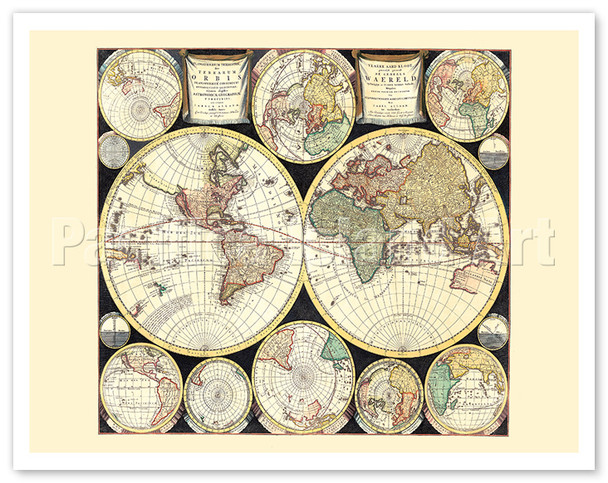
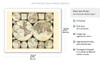
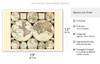
This map is a reproduction of the "Planisphaerium Terrestre, sive Terrarum Orbis" (The Terrestrial Planisphere, or Map of the World) created by the Dutch cartographer and publisher Carel Allard around 1696.
Map Details
Cartographer: Carel (or Carolus) Allard (1648–c. 1709), part of a prominent family of Amsterdam mapmakers.
Date: Circa 1696.
Style: It is a double-hemisphere map, which was a significant departure from the more common, allegorical world maps of the time. It is known as one of the earliest examples of a multiple hemispheric map.
Layout: The main feature consists of two large hemispheres displaying the Western and Eastern worlds. Surrounding these are eight smaller circular projections showing the world from various azimuthal orientations and four smaller diagrams illustrating different projections.
Geographical Inaccuracies: Reflecting the geographical knowledge of the late 17th century, the map notably depicts California as an island, incomplete coastlines for parts of Australia and New Zealand, and a land bridge ("Terra Esonis") stretching between North America and Asia.
View AllClose
This map is a reproduction of the "Planisphaerium Terrestre, sive Terrarum Orbis" (The Terrestrial Planisphere, or Map of the World) created by the Dutch cartographer and publisher Carel Allard around 1696.
Map Details
Cartographer: Carel (or Carolus) Allard (1648–c. 1709), part of a prominent family of Amsterdam mapmakers.
Date: Circa 1696.
Style: It is a double-hemisphere map, which was a significant departure from the more common, allegorical world maps of the time. It is known as one of the earliest examples of a multiple hemispheric map.
Layout: The main feature consists of two large hemispheres displaying the Western and Eastern worlds. Surrounding these are eight smaller circular projections showing the world from various azimuthal orientations and four smaller diagrams illustrating different projections.
Geographical Inaccuracies: Reflecting the geographical knowledge of the late 17th century, the map notably depicts California as an island, incomplete coastlines for parts of Australia and New Zealand, and a land bridge ("Terra Esonis") stretching between North America and Asia.


